

Prologue: A sterile room called the circus, a specimen of the absurd
Federico Fellini's "La Strada" (1954) is not merely a nostalgic classic of Italian cinema. It is an "endless puppet show of traveling performers" performed in the mud in a remote corner of the world
Zampano, a beast boasting of his strength and capable of tearing iron chains with his pectoral muscles, and Gelsomina, an innocent, white-faced clown he has bought, drag their dilapidated three-wheeled truck. This truck is a mobile sideshow that glides silently through the vast Italian landscape, and also a small, sterile room cut off from the outside world
Gelsomina—Giulietta Masina as Fellini's "angel"
In the world Fellini creates on screen, women are always deconstructed and symbolized into two extreme attributes
One is the "excessive body (monster)" as a symbol of insane motherhood. These are "insane women" who exude overwhelming physicality and a raw, visceral sense of life, exemplified by Saraghina, the giantess on the beach in "8 1/2," and the voluptuous tobacconist in "Amarcord."
Another type is the "unattainable star (THE actress)" as a perfect, unattainable aesthetic symbol. These are abstract on-screen idols, like Anita Ekberg standing by the Trevi Fountain in "La Dolce Vita" or Claudia Cardinale in "8 1/2"
Because Fellini himself was a spendthrift and a director consumed by his own dark desires and fantasies, the images he depicted always swung to the extremes of "grotesque bodies" and "expensive ostentation."
However, the Giulietta Masina is unique in that it doesn't belong to either of these categories
- A third form that is neither a "mad body" nor a "haughty actress": She is neither the target of Fellini's gritty sexual desires nor possesses the guise of a pretentious great actress. Clad in an oversized coat, with large, wide-open eyes simply gazing at the world, she is the only "transparent, sacred avatar" that the mad director Fellini placed alone in his sterile room.
- A "light source" that neutralizes dark fantasies: In Fellini's structure, which directly visualizes murky, dark desires, the insertion of Gelsomina, played by Giulietta, as a "third sanctity," allows his films to avoid becoming mere runaway fetishism and instead remain as "supreme art" imbued with mythical salvation and sorrow.
Giulietta Masina's portrayal of Gelsomina is the most beautiful "mechanical doll" in film history
While Fellini's cinematic world is steeped in excessive physicality and insidious desires, his wife, Masina, always stood out as an exception. She was the only "transparent angel (muse)" who descended upon the gritty, superficial world of the master Fellini, and the "illuminator of light" that brought mythical salvation to his works
- Chaplin's influence and the symbolization of "Sacred Pierrot": an oversized old coat, a hat perched precariously on her head, and heavy white makeup that exaggerates her facial features. Her attire is Chaplinian, yet it strips away any cuteness, frantically extracting only a pure, innocent transparency.
- The emotions of a figure devoid of words: She doesn't express her emotions with eloquent words. Her exaggerated, pantomime-like gestures, her wide-open eyes, and her small lips that seem to blow a trumpet—she is less a human being and more a clean clown figure sculpted to physically embody the emotions of "sorrow and love."
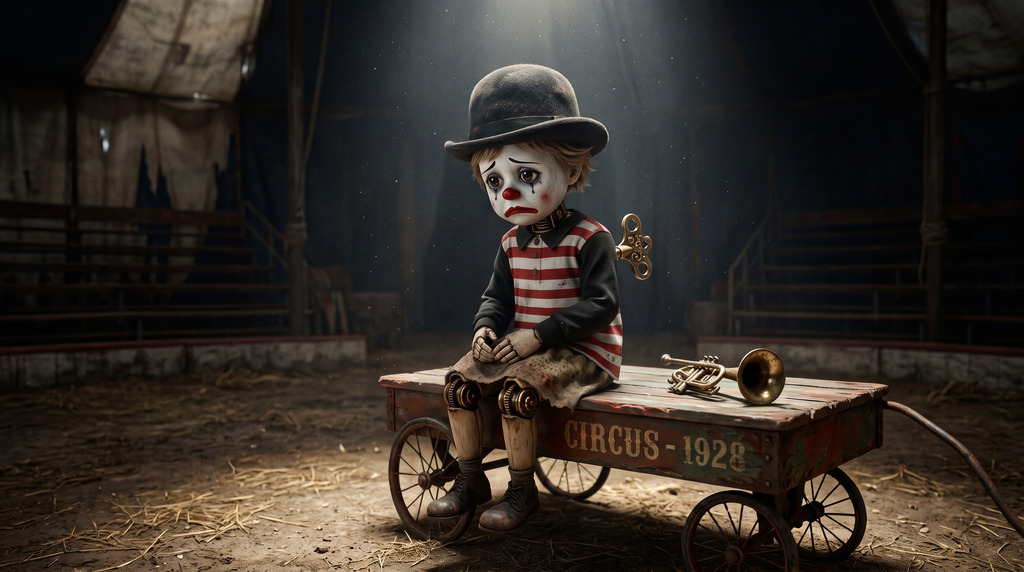
Zampano the Clown—The Loneliness of a Beast Bound by Gravity
Anthony Quinn's portrayal of Zampano is the complete opposite of Gelsomina's "light and transparent" character; he is a man hardened by mud and gravity
- A savage body and a fixed role: clad in a leather jacket, flaunting his chest muscles, he performs the simple task of cutting iron chains. He cannot escape the mask of his own savagery and clumsiness. With a miraculous angel like Gelsomina beside him, his violence, which can only be expressed through destruction, is a tragedy of a flesh-and-blood body bound by an absurd fate.
- Dismemberment and tears on the beach at night: In the final scene of the story, after abandoning Gelsomina, he clutches the sand on the beach at night, looks up to the sky, and weeps. It is here that his formidable armor (mask) of cynicism finally crumbles, and the body of a lonely man is exposed on the dissection table.
Fellini's "Pagliacci" and Nino Rota: Lost Signs and "Automatic Melodies"
Later, in the TV movie "Fellini's Clowns" (1970), Fellini documented, in a semi-documentary style, how the clowns who once captivated the world grew old, were forgotten, and disappeared along with the circus tents. There is a definitive sense of resignation and nostalgia in it, conveying the message that "clowns no longer exist anywhere in the world."
- The film as a coffin for the vanished clown: Gelsomina in "La Strada" was truly the last glimmer of a fading clown. In the final scene of "Pagliacci" by Fellini, two old clowns quietly play their trumpets in an empty circus tent as the spotlight fades out. That scene of the end is also a belated funeral dirge for Gelsomina, who vanished in "La Strada."
- Nino Rota's "eternal memory device": Even as times change and real clowns disappear from the world, the poignant melodies written by Nino Rota will never fade. Gelsomina's weak trumpet melody continues to function as an "emotional auto-playing device (music box)" that brings the ghost of the vanished circus back to the screen again and again.
The clowns depicted by Fellini, inhabited by the angel Giulietta Masina, are precursors to modern symbolic culture and "beautiful specimens of decay" that can never be recreated
The white-faced clown (Gelsomina), the beast bound by gravity (Zampano), and Gelsomina's theme resounding in the empty circus tent. These symbols, laid out on a sterile dissection table, still quietly grip our hearts as a pure elegy lost to the world
And wasn't Fellini himself, the monster who built a vast cinematic empire and scattered countless desires and fictions, in the same position as Zampanò? In the end, what he left behind was not lavish sets or excessive physiques, but that dilapidated three-wheeled truck sitting alone in the corner of the wilderness and the small mechanical doll blowing a trumpet—that is, the original landscape of Giulietta Masina, namely "La Strada."